Community Astronomy Clubs in the UK: How to Find One and What to Expect
A practical guide to finding a UK astronomy club, what happens at meetings and star parties, and how to...

Stand in a dark garden on a clear night and the sky can feel both enormous and strangely flat. The stars are there, but the detail is not. A pair of binoculars or a small telescope changes that, and it is one of the few purchases in amateur astronomy you cannot easily undo. Buy badly and the gear lives in a cupboard. Buy well and you will still be reaching for it in ten years.
The useful answer is not "which instrument is better" but "which one suits the way you actually observe". Consider where you live, how much you carry, how often you get outside, and what you most want to see.
Binoculars are the most underrated instrument in the hobby. They show the Moon's larger craters, Jupiter and its four bright moons, the Pleiades, the Orion Nebula and a scattering of star clusters. Everything appears the right way up, the field of view is wide, and you can find your way around the sky without a map and a torch.
They are also forgiving. There is no mirror to align, no mount to polar align, nothing to cool down. You can hold them one-handed, take them on holiday, and use them in daylight for birds, aircraft and distant hills. A 10x50 or 8x42 pair is a sensible all-rounder: the first figure is magnification, the second the diameter of each front lens in millimetres. Avoid 20x50 models, which sound powerful but shake badly and gather little light for the magnification they offer.
If yours wobble, a tripod adapter and a cheap sturdy tripod will steady the view more than any upgrade to the glass.
A telescope gives you magnification you can change and resolution you cannot fake. It shows Saturn's rings from roughly 60x upwards, Jupiter's cloud belts, the polar caps of Mars when it is well placed, tight double stars split cleanly, and globular clusters resolved into individual points of light. Under dark skies, brighter galaxies and nebulae stop being grey smudges and start showing shape.
The trade-off is complexity. The field of view is narrow, so finding anything takes practice. The mount must be stable, which often costs more than the optics. Reflectors need time to cool to the outside temperature, and telescopes with a front corrector plate can dew up quickly. A tabletop Dobsonian of around 130mm to 150mm is a common and sensible first choice: simple, stable and quick to set up. Be wary of department-store telescopes advertising extreme magnifications, since a shaky mount and a poor eyepiece will undo whatever the tube promises.
A modest outlay buys genuinely usable binoculars. The same money spent on a telescope usually buys an entry-level instrument with a compromised mount, which is the most common reason beginners give up.
With binoculars, most of the cost is in the glass. With telescopes, it is split between optics, mount and eyepieces, and the mount is the part manufacturers cut first. If you choose a telescope, budget for a second eyepiece and a red-light torch rather than spending everything on aperture.
This is where the two diverge sharply, and it matters more than most reviews admit.
Light pollution, streetlamps and a bright neighbour's security light will test your commitment. The easier something is to carry out, the more often you will use it, and frequency beats aperture over a year of observing.
Nobody regrets starting with binoculars. Plenty of people regret buying a telescope badly.
Be realistic about the difference. Both instruments reward patience and dark skies far more than extra magnification.
Binoculars show you where things are. A telescope shows you what they are. Many observers keep both, using binoculars to plan a session and the telescope to finish it.
Finding objects is a skill, and it takes a few evenings to acquire. Learn two or three bright constellations properly, use a red-light torch to protect your night vision, and give your eyes twenty minutes to adapt before judging anything. Start with the Moon and Jupiter, which are bright enough to find from a town garden, then work outwards. A simple star chart or a phone app used at low brightness will carry you a long way.
If you are undecided, start with binoculars. They cost less, teach you the sky, and remain useful whatever you buy next. When you eventually add a telescope, you will know which targets you care about, and that knowledge is worth more than any specification.
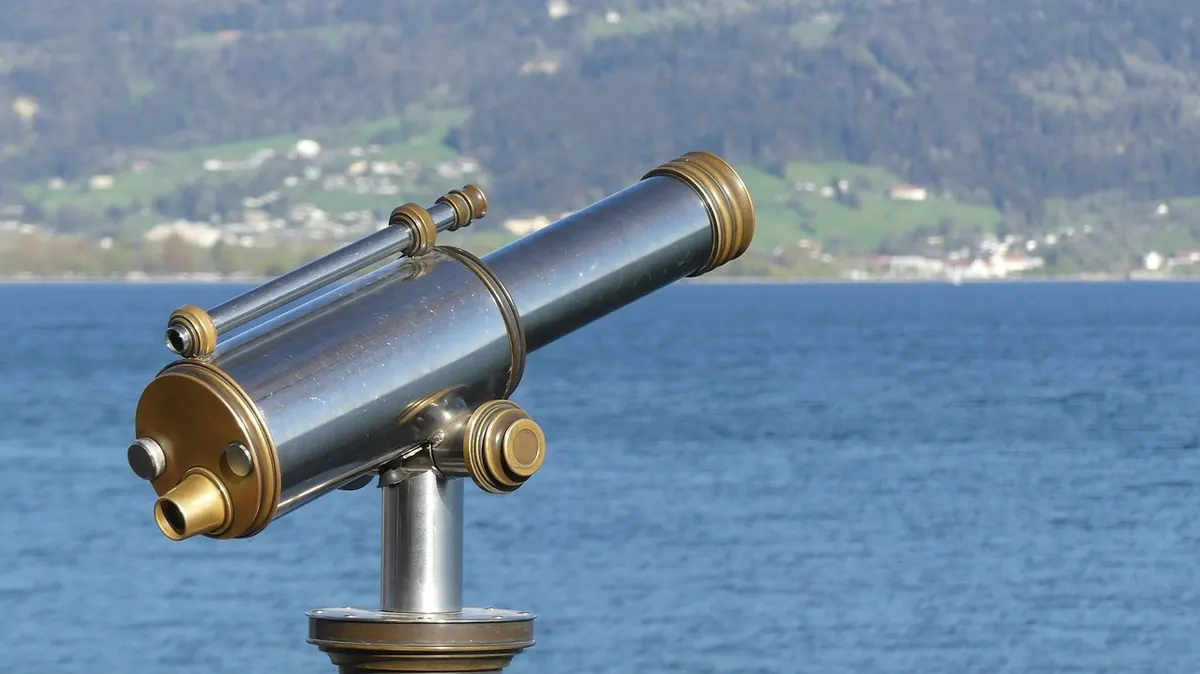
Photo: kisistvan77 / Pixabay
A practical guide to finding a UK astronomy club, what happens at meetings and star parties, and how to...
The northern lights are rare from Britain but not impossible. Here's how forecasts, dark-sky sites and...
A practical first-night guide to assembling, aligning and focusing a new telescope, with a checklist to...