Community Astronomy Clubs in the UK: How to Find One and What to Expect
A practical guide to finding a UK astronomy club, what happens at meetings and star parties, and how to...

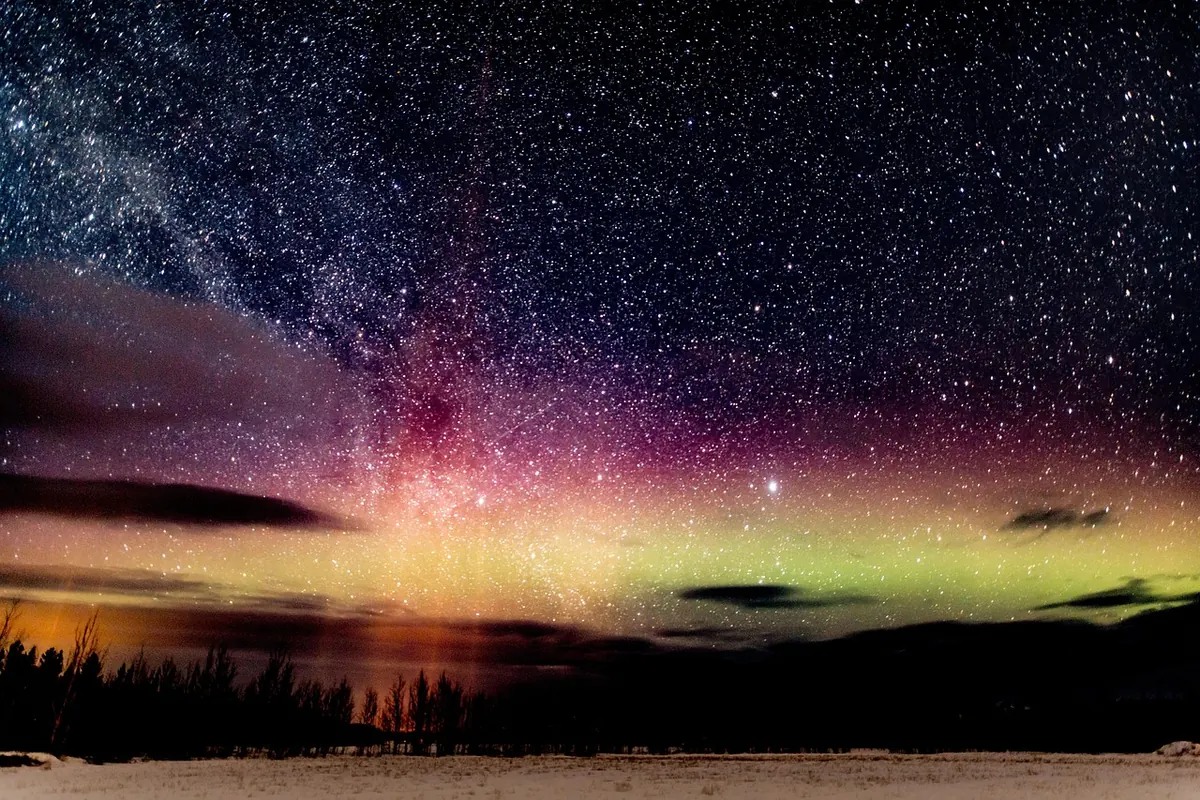
Every few weeks someone in Shetland posts a photograph of green fire over a croft, and the rest of the country looks up. The northern lights are not a Scottish-only spectacle, but from Britain you are always watching a faint, marginal version of the show that Iceland and Norway get as routine. That is precisely why preparation counts. Understanding a forecast, choosing a genuinely dark site and setting up your camera before you leave the house will not guarantee a sighting, but they will put you in the right place when the sky finally moves.
Charged particles streaming from the Sun are funnelled along Earth's magnetic field towards the poles, where they collide with oxygen and nitrogen high in the atmosphere. Those collisions release light: green and red from oxygen, purple and pink from nitrogen.
The auroral oval normally sits over northern Scandinavia, Iceland and the Arctic. Britain lies just south of it, so we usually catch the edge of the glow, if anything. When a geomagnetic storm disturbs the field, the oval expands southwards and the UK comes into range. During the strongest storms the lights have been reported as far south as Cornwall, though that is genuinely rare.
For practical purposes, treat Scotland — Shetland, Orkney, Caithness, Aberdeenshire, the Highlands — as your best bet. Northern Ireland and northern England follow. The further south you are, the stronger the storm needs to be.
Almost every aurora forecast you meet is built around the Kp index, a 0–9 scale describing how disturbed Earth's magnetic field is on a planetary level. It is useful, but it is also the most misunderstood number in the hobby.
Two things are worth remembering. First, Kp is global, not local: a Kp 5 night can produce a fine display over Shetland and nothing at all over Norfolk. As a rough guide, northern Scotland can catch a glow from around Kp 4–5, while Northern Ireland and northern England often need Kp 6 or more. Second, Kp is a lagging indicator.
Check the Met Office space weather pages, NOAA's Space Weather Prediction Center, AuroraWatch UK and Space Weather Live. Aurora alert apps are handy for waking you at the right moment, but they are no substitute for looking outside.
Light pollution does not stop the aurora, but it flattens contrast and hides faint structure. A truly dark sky lets you see a weak arc that would be invisible from a town.
Britain has several official dark-sky areas that work well for aurora hunting: Galloway Forest Park, the Northumberland International Dark Sky Park around Kielder, the Cairngorms, Eryri, Exmoor, the Yorkshire Dales and the North York Moors. The Hebrides, Skye, Orkney and Shetland are better still, if you happen to be there.
More important than the badge on the sign is your northern horizon. You want an unobstructed view north, ideally over sea or flat ground, with no town glow in that direction. A beach car park on the east coast of Scotland can beat a famous dark-sky park with a hill in the way.
Aurora happens year-round, but you can only see it when the sky is dark. In practice that means September to March, with the weeks around the spring and autumn equinoxes tending to bring more active conditions.
The hours either side of local midnight are usually the most productive, though displays arrive in short bursts and can fade for an hour at a time. Avoid a full moon if you have a choice; it washes out faint detail. Cloud, not solar activity, defeats most UK attempts, so check a cloud forecast before you commit to a drive.
Set your expectations sensibly. Most UK aurora looks like a pale grey-green arc low in the north, or a brighter patch that slowly brightens and dims. Vivid curtains of colour are possible, but they are the exception.
The reason is how your eyes work. In low light you rely on rods, which do not detect colour well, so a display a camera renders bright green may look almost white to you. Give your eyes 20 to 30 minutes to adapt, use a red torch rather than a phone screen, and try averted vision: look slightly to one side of the arc and it often appears stronger. Look low — roughly 10 to 30 degrees above the northern horizon is where the UK action usually sits.
A camera sees more than you do, which makes photography a good way to confirm a faint glow.
Phones can do surprisingly well. Rest the phone on something solid, use night mode, turn off the flash and give it several seconds. Do not judge the display by the screen — a green frame produced from a grey smear in the sky is a perfectly normal result.
When an alert lands, work through this quickly. Check the forecast and the cloud picture. Pick a site within an hour's drive with a clear northern horizon, and decide before you leave rather than improvising in the dark. Dress for several degrees colder than the forecast suggests, take a flask and a red torch, and tell someone where you are going if you are heading somewhere remote.
Once you arrive, give your eyes time, stay off your phone and be patient. Set an alarm for the early hours if you can, and keep glancing north. Plenty of people miss displays simply because they went home at 11pm.
And if you see nothing? That is the normal outcome in Britain. The aurora rewards persistence and a bit of luck rather than promising anything. The forecast-watching habit is worth building anyway — the same dark, clear nights that bring the lights also bring the best of the winter sky.
Photo: steveowst / Pixabay
A practical guide to finding a UK astronomy club, what happens at meetings and star parties, and how to...
A practical first-night guide to assembling, aligning and focusing a new telescope, with a checklist to...
What Happens to the Human Body in Space? A Beginner's Guide EXCERPT: Weightlessness reshapes bones,...